Finding an empty parking space in New York can feel like a small win. But before you pull in, you need to know whether your car fits—and whether you can leave it there.
Parallel parking in NYC takes patience, a little practice, and a careful look at the signs. A spot that is legal now may become restricted before you finish lunch.
This guide explains how to park safely, understand the main rules, and compare cheaper options. With a plan and a backup space in mind, you can spend less time circling blocks and more time enjoying the city.
Parallel Parking in New York City: What to Know Before You Start
Busy streets can make parking feel harder than it really is. There may be cars behind you, bikes beside you, and people walking near the curb.
Focus on finding a safe, legal space instead of grabbing the first gap you see.
How to Find a Space That Fits Your Vehicle
Choose a space with enough room to turn in and adjust your position. A gap that barely fits your car may leave you unable to enter safely or get out later.
Check the curb too. Snow, broken pavement, or other objects can reduce the space you have.
If you are driving an unfamiliar rental car, choose a larger gap. Giving yourself extra room is better than guessing where the bumpers are.
Check Parking Restrictions Before Pulling In
Look at the signs before attempting to park. Check whether the space is available for the whole time you plan to stay.
For example, a spot might be legal at noon but become a restricted loading area later in the afternoon.
When planning your visit, our guide to budget travel in New York City can help you balance parking with food, transport, and other costs.
Parallel Parking in NYC: Step-by-Step Instructions
Move slowly and keep checking your surroundings. If someone honks, stay focused on completing the move safely.
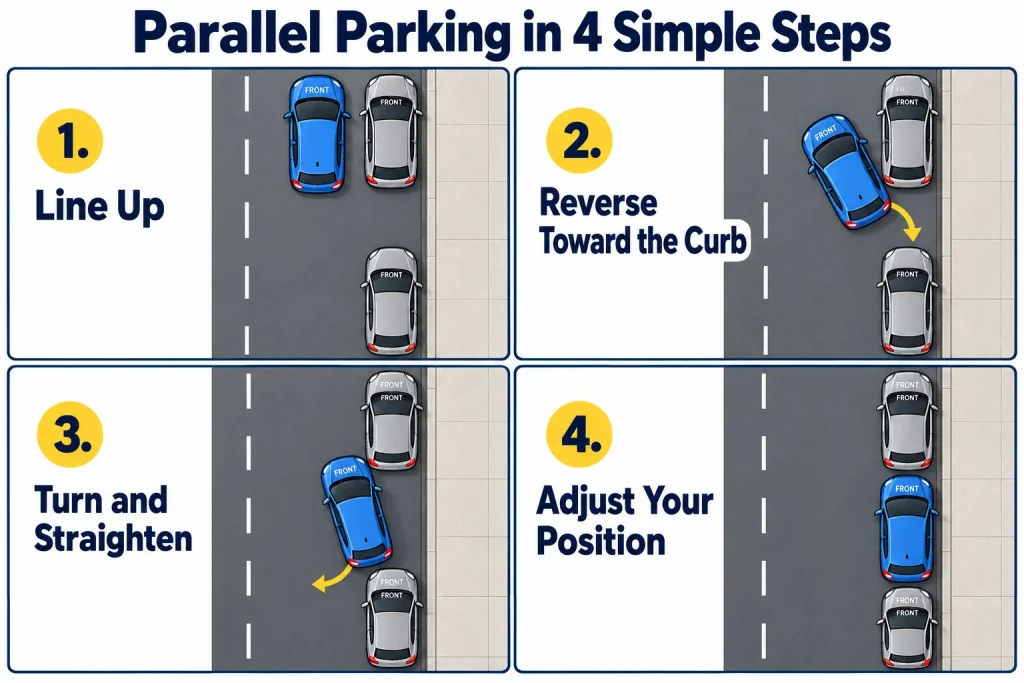
The following steps describe parking beside a curb on your right. Reverse the steering directions when parking on the left.
Signal Early and Position Your Vehicle
Check your mirrors and signal toward the space.
Pull alongside the vehicle parked ahead of the gap, leaving about two feet between your car and that vehicle. Stop and check that you have room to reverse.
Reverse Slowly and Steer Into the Space
Look over both shoulders and check behind you. Begin reversing slowly while steering toward the curb.
Watch the front of your car as well as the back. Your front end swings outward during the turn.
When your front wheels reach the area beside the parked car’s rear bumper, steer away from the curb while continuing to reverse carefully. Stop before getting too close to the vehicle behind you.
Straighten Your Wheels and Adjust Your Position
Straighten your wheels and gently move forward if needed. Leave room for the cars ahead and behind.
Your wheels should finish no more than one foot, or about 30 centimeters, from the curb. These are general steps, so adjust them to your vehicle and the space. dmv.ny.gov
Exit the Space Safely
Before pulling out, check your mirrors and look over your shoulder. Signal and wait for a safe gap.
Watch especially for cyclists passing beside the parked cars. Move out slowly, leaving enough room to clear the vehicle ahead.
NYC Parking Rules You Need to Understand
Good parking is about more than steering. You also need to know what the signs allow.
How to Read NYC Parking Signs
Check the whole block and read every sign that applies to your space. Pay attention to arrows, days, hours, and vehicle types.
When rules overlap, follow the stricter restriction that applies at that time. Review the city’s official NYC parking regulations if you are unsure about the general rules.
Here is a simple example: a sign says “No Parking Monday, 9 a.m.–10:30 a.m.” If you arrive at 8:45 a.m. on Monday, you cannot leave the car there through the restricted period.
No Parking vs. No Standing vs. No Stopping
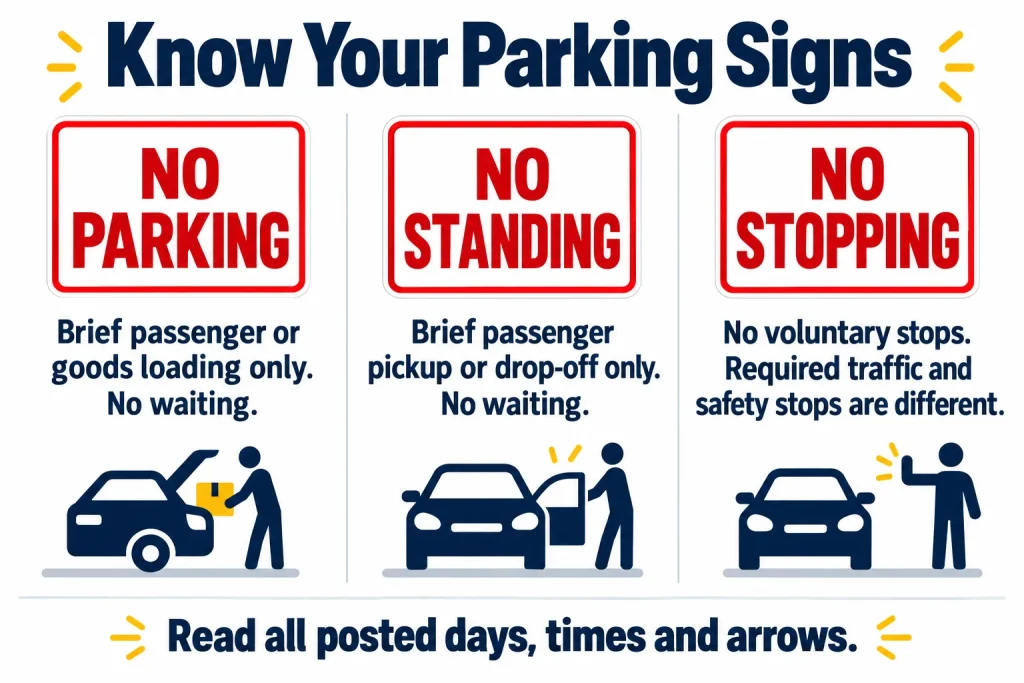
These signs sound similar, but they have different meanings.
| Sign | What it generally means |
|---|---|
| No Parking | You may briefly load or unload people or goods, but you cannot wait there. |
| No Standing | You may briefly pick up or drop off people, but you cannot wait or load goods. |
| No Stopping | You cannot stop voluntarily, even for passenger pickup. Required traffic or safety stops are different. |
Keeping the engine running or staying inside does not make waiting legal.
Alternate Side Parking and Street Cleaning
Alternate Side Parking, or ASP, keeps spaces clear so the street can be cleaned. Signs show the days and hours when parking is restricted.
The restriction lasts for the full posted period, even if the street sweeper has already passed. Check NYC311 for the current suspension status before relying on a holiday or weather exception. portal.311.nyc.gov
An ASP suspension does not automatically cancel other restrictions or meter payments.
Fire Hydrants, Driveways, and Restricted Spaces
When leaving your car, keep at least 15 feet clear on either side of a fire hydrant.
Also, keep driveways and crosswalks clear. Watch for bus stops, loading zones, and spaces reserved for people with disabilities.
Do not assume a space is legal because another car is parked there. That driver may simply be taking a risk.
Parking Meters, Payment, and Time Limits
Check the meter and signs for the price, payment instructions, and maximum stay.
At a pay-by-plate meter, you enter your license plate details. Older pay-and-display meters require a dashboard receipt when you pay at the meter. ParkNYC is another payment option.
Buying more time does not override the posted maximum stay. Follow the location’s rules even if your payment method allows you to add time. Parking Meters
NYC Parking Tips for Busy Streets and Tight Spaces
A few small habits can make parking less stressful, especially during a first visit.
Plan Your Parking Before You Arrive
Choose a first option and a backup before driving into the area.
You might try street parking first, then use a nearby garage if you cannot find a suitable space. Check the garage entrance in advance so you are not searching for it in traffic.
Give yourself a limit on how long you will look. Driving around for half an hour can turn a cheap space into an expensive use of your day.
Use Cameras Without Relying on Them Alone
A parking camera can help you judge distance, but it cannot show everything happening around your car.
Keep checking directly for people and bikes. Stop if someone enters your path.
Know When to Skip a Difficult Space
Pass on a space if visibility is poor, the gap is too tight, or you cannot enter safely.
A short walk from a larger space may be easier than several stressful attempts outside your destination.
Practice in a quiet area before your trip if parallel parking makes you nervous.
Check Before Opening Your Door
Look behind you before opening a door toward the street. A cyclist may be approaching even when no car is nearby.
Take your bags out carefully too, without stepping into moving traffic.
For more ways to prepare, browse our practical travel tips.
Where to Park in NYC: Street Parking, Garages, or Lots?
The best choice depends on how long you will stay, where you are going, and how much walking works for your group.
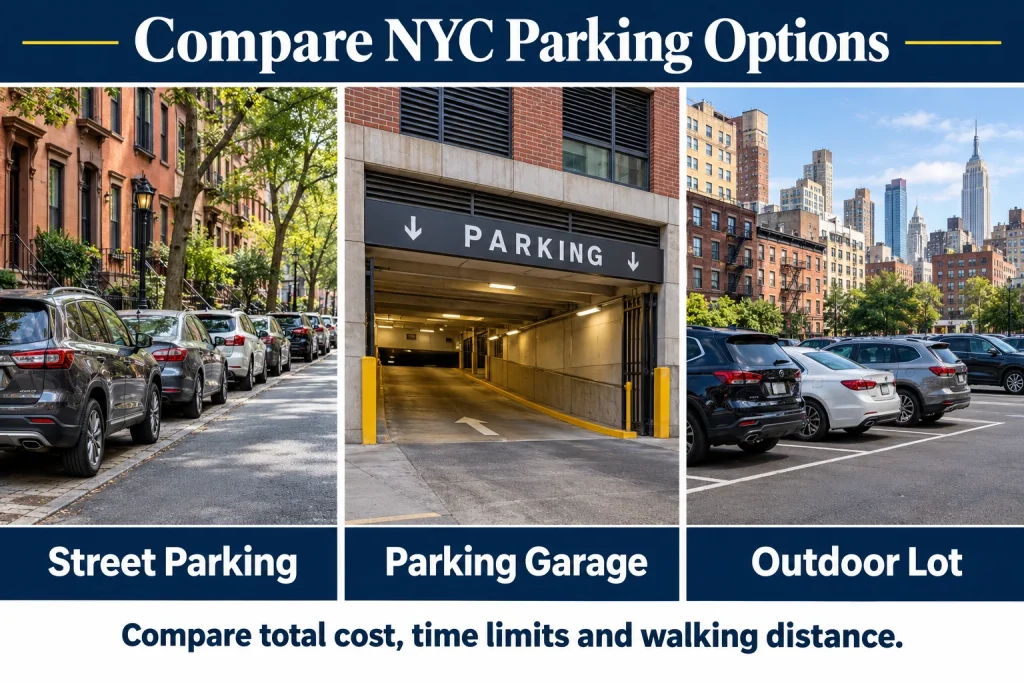
Street Parking for Short Visits
Street parking can be useful when you find a legal space with enough time for your stop.
However, include search time in your plans. It may be a poor choice when you have a timed ticket or appointment.
Unmetered spaces still have rules, so check them as carefully as paid spaces.
Parking Garages for Longer Stays
A garage is worth comparing when you want to leave the car for several hours.
Check opening hours, height limits, and charges for larger vehicles. Find out whether an attendant parks your car and whether you need to leave your keys.
Also, confirm how late you can collect the vehicle.
Outdoor Parking Lots as an Alternative
An outdoor lot may offer another useful option near your destination.
Check the total price, closing time, and whether staff are present. Look at the walking route rather than judging the location only by its distance on a map.
Parking Near Transit and Taking the Subway
Another option is to park near a useful subway station and finish the trip by train.
Compare parking plus fares for everyone in your group. Confirm that the space allows your whole stay; a lot near a station is not automatically open to commuters.
Our guide to saving money on public transportation can help you plan the next part of the journey.
| Parking option | Useful when | Main things to check |
|---|---|---|
| Street parking | Your visit fits the posted time limits | Signs, payment, cleaning schedule |
| Garage | You want a planned space for a longer stay | Full price, opening hours, vehicle limits |
| Outdoor lot | There is a suitable lot nearby | Access, staffing, collection time |
| Parking near transit | You can finish your journey by train | Parking cost, fares, travel time |
How to Find Cheap Parking in New York City
Cheap parking depends on your exact location and length of stay. Compare the full cost before choosing.
Compare Street Meter Prices by Area
NYC meter prices vary by zone. The second hour can cost more than the first.
Here are examples from NYC DOT’s published rates for “All Vehicles” meters, checked in October 2026:
| Meter zone or area | First hour | Second hour | Two hours total* |
|---|---|---|---|
| Midtown Core and Lower Manhattan | $5.50 | $9.00 | $14.50 |
| Business districts outside Manhattan, such as Downtown Brooklyn | $2.50 | $5.00 | $7.50 |
| Neighborhood retail districts | $2.00 | $3.00 | $5.00 |
| Other metered locations in Zone 3 | $1.50 | $2.50 | $4.00 |
Two-hour totals apply only where the posted rules allow a two-hour stay.
Check the meter for the exact space. Review the official NYC parking meter rates before your visit because prices and rules can change.
A lower meter rate elsewhere is useful only if that location works for your plans. Add any extra walking or transit costs.
Check Early-Bird, Evening, and Weekend Offers
Compare garage offers for your actual arrival and departure times.
An early-bird price may require arrival before a certain hour and departure by a set time. Evening and weekend deals may also have limits.
For example, a lower price is not helpful if its collection deadline falls halfway through your dinner.
Look Beyond the Closest Block
Compare a few options within a comfortable walking distance.
You may find a better price farther from your destination. Still, think about rain, luggage, children, and anyone who finds walking difficult.
Choose a saving that works for your group rather than the lowest number alone.
Check the Final Price and Extra Fees
Ask whether taxes and booking fees are included. Check for extra charges for SUVs, vans, or other large vehicles.
For a garage with an attendant, include any tip you plan to give in your budget.
Our budget travel guides offer more ideas for managing your total trip cost.
Read Cancellation and Return Rules
Check whether you can cancel if your plans change.
Also, ask whether you can drive out and return on the same booking. Some bookings cover only one entry, so leaving may mean paying again.
Save the booking details and garage address before setting off.
Common Parallel Parking Mistakes in NYC
Most mistakes come from rushing or assuming a space is allowed.
Reading Only the Nearest Sign
A sign farther along the block may also apply. Check the arrows and the full time you intend to stay.
Assuming an Empty Space Is Legal
An empty gap may be a driveway, a restricted zone, or too close to a hydrant.
Treat it as a possible space until you have checked.
Squeezing Into a Space That Is Too Small
If you cannot leave reasonable room for nearby vehicles, choose another spot.
Protecting your car—and everyone else’s—is worth a little more searching.
Forgetting When You Must Move
Set a reminder early enough to walk back before your paid time ends or a restriction begins.
Do not double-park while waiting for cleaning to finish. NYC prohibits double parking passenger cars, including during street-cleaning periods. portal.311.nyc.gov
Frequently Asked Questions About Parallel Parking in NYC
Is Parallel Parking in NYC Difficult for First-Time Visitors?
It can feel difficult because of traffic and unfamiliar signs. A roomy space, slow movements, and a backup garage can make it easier.
How Close to the Curb Should You Park?
Your wheels should be no more than one foot, or about 30 centimeters, from the curb.
Can You Park on Both Sides of a One-Way Street?
Yes, where parking is otherwise permitted on each side. Your car must face the direction traffic travels.
Check both sides separately because their restrictions may differ.
Is Street Parking in NYC Free on Sundays?
Meter payment rules are not in effect on Sundays. However, other restrictions still apply, so check the signs before leaving your car.
Does an Alternate Side Parking Suspension Mean All Parking Is Free?
No. Suspending street-cleaning rules alone does not remove meter charges or other restrictions. Major legal holidays have separate rules.
Is Street Parking Always Cheaper Than a Garage?
No. Compare the meter cost for your allowed stay with the garage’s final price. A garage offer may work better, especially for a longer visit.
Final Checklist Before You Park in NYC
Before walking away, check that:
- Your car fits, and nearby vehicles have room to move.
- The space is legal for your whole stay.
- Hydrants, driveways, and pedestrian routes are clear.
- Your car sits close enough to the curb.
- Payment is complete, if required.
- You have set a reminder for when to return.
- It is safe to open your door.
Give yourself time, choose a suitable space, and keep a backup ready. Once the car is safely parked, you can focus on the part you came for: exploring New York.

Silas Harlow
Silas Harlow is a travel writer and budget travel researcher at TravelBee Trips. He creates practical guides covering destinations, accommodation, transportation, attractions, safety, and affordable travel planning. His research uses official tourism resources, government websites, maps, and established service providers where available. Because travel information changes frequently, readers should verify important details before booking. View his complete author profile and editorial approach.